
Whose Memories are Worth Preserving?
For my March article I delve into Aanchal Malhotra's Remnants of a Separation and Explore the Asymmetry in our Historical Accounts.

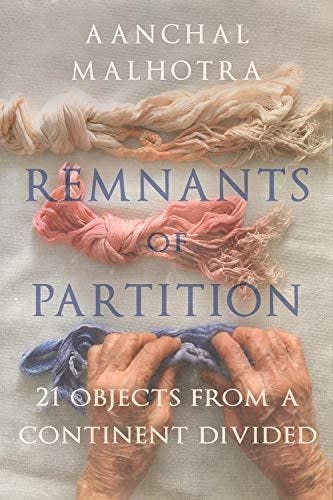
There are many ways to preserve history for the future generations- pictures, documents, treaties, newspapers, monuments, museums- all play a specific role in communicating the past to us. Aanchal Malhotra delves into the murky history of India’s partition in her book Remnants of Partition through objects carried over the borders by the survivors.
Some objects have practical value such as a pair of rusty scissors, or an iron meter scale, while others have material value such as a maang teeka made of pearls, a cigarette holder made of silver, a pashmina shawl cut in half- but each of these objects is also saddled with an extra weight of emotions. Each object is tied to a memory, an ephemeral feeling. Each object acts as a portal to a world that these people left behind to start a new life in another country. Malhotra deftly uses these memories that come tethered to the objects to recreate what India and Pakistan looked like at the time. These conversations primarily deal with grief and the rupture of leaving a life behind to build a new one somewhere else.
The book reads like a museum, and like any museum, the book is also a factor of the curator’s decision-making.
Almost every voice in the book speaks with remarkable restraint and equanimity. The narrators lean into the nostalgia of their upbringings, their houses, their neighbours and emphasise, repeatedly, that everyone suffered during Partition. That Hindus, Muslims, and Sikhs were all victims of a terrible historical moment. That the violence was tragic but collective. That no single community bears responsibility.
These statements sound dignified and stripped of raw pain and grief that one would expect from a population that has gone through such a violent and tumultuous experience. They almost feel like they have been made by a historian or an ambassador of peace. And I can’t help but wonder to myself, if this is how all traumatised people remember the past?
Assuming that these stories were indeed told by the interviewees themselves and not just attributed to them- what could possibly be the reason for almost each interviewee to have spoken with such remarkable restraint?
1947’s partition is a blot in the shared history of India, Pakistan and Bangladesh. Apart from uprooting tens of millions of people from their homes, it also led to massacres of varying degrees spanning across several borders, trains, towns and cities in the months leading up to the final moment, triggering deaths and disappearances in millions in its wake.
In my own experience, the memories of Partition that circulate within families rarely sound like this.
Nearly every family I have encountered whose grandparents migrated to India in 1947 carries some residue of anger. Sometimes it appears as grief, sometimes as bitterness, sometimes as prejudice that has calcified across generations. Sometimes it is expressed openly; sometimes it surfaces only in passing remarks, in inherited anxieties, in the particular silence that falls when certain subjects are raised. But it is almost always there. I would be surprised if families on the other side of the border were any different.
Memory, especially inherited memory, is rarely symmetrical.
I assume that it would have been Malhotra’s intentions to keep the narration as apolitical as possible so as to focus on personal grief instead of branching into the bigger political ecosystem that existed at the time. But, retelling of a grief that emanated from a political act such as partition is itself a political act. And this makes me wonder if the moral balance evident in the book serves the memories of the partition or the broad framework under which the book was written.
Each interview that Malhotra manages to clinch for the book weaves a very profound account of how the partition came about not just on paper, but as a historical event with real life ramifications.
Another common thread running through almost each of these interviews is the socio-economic background of these subjects. Somehow, all the people interviewed for the task hail from educated, wealthy and socially privileged families who were forced to leave and start afresh. Sometimes even leaving behind their palatial homes, but always followed by their social capital which aided them in rebuilding their lives.
We get to hear stories from teachers, doctors, landlords, landowners, administrators, police officers, army constables, railway officials, people with generational wealth but never from a daily wager, a farmer, a sewer cleaner, a cobbler, a tailor or a mason.
This is certainly not a case of happenstance, and it needs to be examined from the lens of caste and class privileges. This social capital in many cases allowed them to cross the blood soaked border alive and with objects that they can now touch and reminisce about the good old pre-partition days. The ownership of such objects itself is a factor of class privilege.
This is not to say that having lost someone to partition or not having any memorabilia from that era are prerequisites to a legitimate memory from partition.
But it certainly begs the question why only a certain class of people were chosen and why couldn’t there be more diversity in the pool of people chosen to be interviewed. And this lack of diversity becomes even more conspicuous when you notice Malhotra’s sincere attempts at trying to bring voices not just from India but Pakistan as well and even from the much-ignored eastern border. Why couldn’t Malhotra lend the same attention and pragmatism to choosing people from across socio-economic strata as well?
This is the quiet problem at the heart of the book: memory-through-objects is, by design, a methodology of the privileged.
And once it becomes apparent to you, the emotional register of the book stops confounding you anymore. The balanced and calm retelling, the acknowledgement of the grief on the other side of the border, the quiet refusal to indulge in bitterness start looking like class privilege. Such maturity is available to those who didn’t lose life to riots, not social security and in their case certainly not objects.
The state managed rehabilitation for refuges along the lines of pre-existing socio economic hierarchies- with dalit sikhs and hindus often getting much smaller land parcels in separate settlements like Rehgar Pura and Kingsway Colony. Often the dalit refugees were the last to migrate across the border owing to their economic and almost exclusive dependence on labour intensive jobs and because they’d feature at the tail end of the state’s evacuation priorities. This rendered them more vulnerable to the communal violence compared to others. In contrast, the interviewees recounted stories of fleeing their homes in guarded cavalcades, some in private jets, and some even escorted by the armies.
Dalit Hindus and Sikhs who migrated to India were not housed alongside upper-caste refugees; they were directed to separate camps with deplorable conditions. Their Partition was layered: displacement compounded by systemic discrimination, by exclusion from the resettlement programmes that helped upper-caste families rebuild, by a social order that survived the cartographic violence of 1947 largely intact.
Their absence from The Remnants of Partition is not an oversight in the ordinary sense. It is a structural consequence of the book’s premises. It lays bare the very problem that ails most conversations around the partition of India. The absence is worth naming- precisely because the book is a part of the larger conversation on preserving and remembering India’s mammoth history. Whose history is exactly being rendered literary, and more importantly, whose isn’t?
Remnants of partition doesn’t bring you the universal experience of partition, and maybe that was not even the intended point of the book. It was written for a very specific audience- the diasporic, the liberal and the literature festival enthusiast. The book seems particularly attuned to readers who seek tenderness and reconciliation in historical memory — a vision of the past where the emphasis lies on shared suffering rather than unresolved questions.
Perhaps, this is why the book sits so well with its intended audience.
The book should not pass off as a shared experience of partition, not unless questions that still hold urgency are asked- who benefitted from partition, which communities bore the disproportionate brunt of it and why India wasn’t rebuilt as a secular and equalitarian country instead of relegating to the old order.
Tenderness, here, becomes a way of not asking those questions. But tenderness can also be used to talk about the ugly realities of our existence.
Having said this, it would be a grave disservice to disregard what the book achieves within its own terms. Malhotra does an invaluable job of preserving the stories of our elders and provides a quiet dignity to it. Malhotra’s journal speaks to India’s growing young population who are far removed from the realities on which this very country was once founded. These people have for long consumed material on partition through absurdly jingoistic movies and pop culture references- and for them the book provides grounding education. Partition did not create one memory. It created millions. And each story deserves space and an opportunity to be heard.
Some memories are nostalgic. Some are bitter. Some are silent in ways that have never found the right room to become loud. Some survive through objects kept carefully in drawers for decades. Others survive only through fragments of stories at dining tables, through inherited fears, through jokes that are not entirely jokes, through a particular hardening around the mention of certain names. And some do not survive at all because the people who carried them had nothing to carry, and didn’t survive the double ordeal of migration and social constraints. Objects carry memories beautifully as they invite conversations and recollections. But equally important are memories that aren’t tethered to anyone or anything.
The history of Partition is still being written. Books like The Remnants of Partition are a part of that writing. Beautiful, necessary, but also incomplete.