
Where do we even Belong?
Hisham Matar's My Friends leaves you deeply upset and flustered- is it the pain of exile, or are you just mourning lost opportunities?

My friends by Hisham Matar is a deeply affecting novel- is not merely an opinion but a fact. It’s a hauntingly poignant account of trauma, anger and stolen possibilities of displaced people. This novel is also a deeply political one, and one very fitting to our times. Here are three friends, all forced to go into exile in a foreign country by a dictator, showing you how differently their lives still pan out despite being in the same circumstances and having the same political leanings. For a world where so many among us are still insisting on keeping the personal out of the political- this novel shows how despite being on the same side politically as your friends, politics still finds a way to wedge into your personal life. It shows that the personal was always hands in gloves with the political.
The book starts when Khaled is seeing his friend Hosam off at London’s St Pancreas station, where Hosam is boarding the Chunnel to Paris to start afresh in America. Khaled is certain that he is seeing Hosam for the last time ever. Khaled describes this with a certain degree of dispassion but you can detect a certain heaviness that only those with a universe of despair within them can only employ. You could almost imagine them as former lovers, who have retained respect and gratitude for each other, but are now so far removed from each other, that even if they reached out to each other with an outstretched hand, the fingers would never touch.
While Hosam departs invigorated with the prospects of a new life, Khaled- so uprooted and unsettled- begins his long journey home on foot, roaming the streets of the city, while revisiting places central to his many years there and recollecting memories of other cities that once wanted him to call home, but to which he couldn’t commit. such as his Libyan birthplace of Benghazi, Paris, where he first met Hosam, and Edinburgh, where he first came to university after he left Libya at eighteen. There he found a fellow student named Mustafa and bonded for their future.
At Edinburgh University, in a lecture on Tennyson’s “In Memoriam” Professor Walbrook makes an observation that defines the fundamental dilemmas to soon overwhelm Khaled’s life: “Here we have two untranslatable experiences. The first is the friendship, which, like all friendships, one cannot fully describe to anyone else. The second is grief, which again, like all forms of grief, is horrible exactly for how uncommunicable it is.”
The central antagonist to the lives of the three friends is the Libyan Dictator Muammar Qaddafi, whose dictatorship is the overarching theme of their lives and casts its shadow on everything. Even in Edinburgh, where Khaled and Mustafa are as students they are inundated with news of opponents of the regime getting imprisoned and assassinated, even if living abroad, as in London. It is in London that young Khaled and Mustafa, on what they expect to be a brief trip from Edinburgh, make a casual decision that upends the life they have known.
Hasam Mitar’s both lives- real and fictional (Khaled)- are marked by tragedies brought upon by Qaddafi’s regime.
While walking through London as Hosam leaves- Khaled forces himself to return to the site where years ago as young students at Edinburgh University, Khaled and Mustafa had participated in a protest against the Libyan government outside its London Embassy on St. James Square. This was where some men in uniforms had shown up at the gate and opened fire at the protestors. Khaled and Mustafa are both gravely injured and are forced to spend weeks at the hospital-with his midsection forever scarred and disfigured. The incident transforms Khaled and Mustafa’s friendship into a lifelong bond as they are forced to shut out the rest of the world. They can’t return home as they might get arrested by the government, they can’t return to the university for a student acting as the government’s informant might snitch on them, they can’t open up to their families either as they don’t know who is intercepting their calls. Effectively, having lost control over their lives, they are trapped in London. It turns out, as revealed many years later, Hosam too was outside the embassy at the fringe of the protesters but walked away unharmed. The British give Khaled permanent residency, but for his safety he must exist under a false identity.
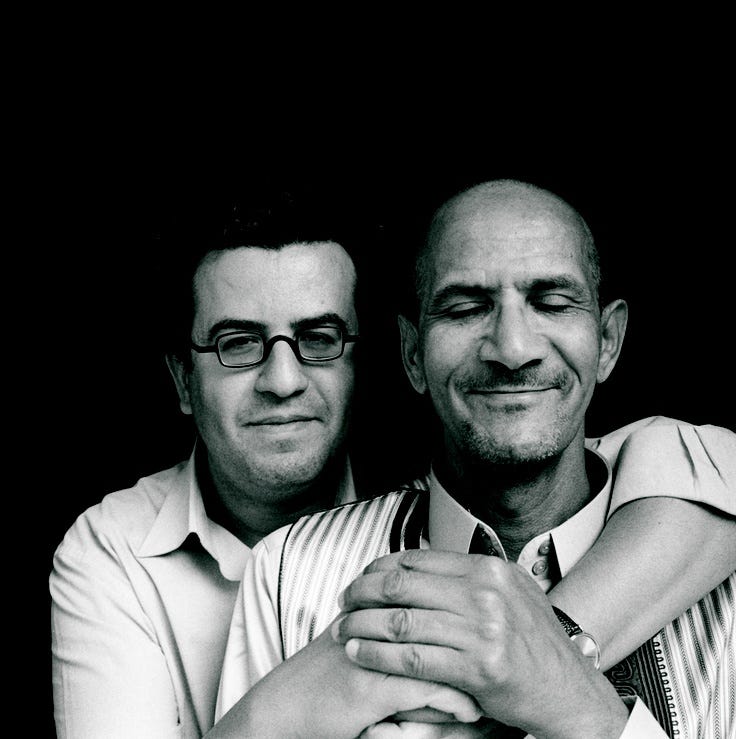
The April 17, 1984, embassy shooting is a historical event, although Matar, unlike his fictional creations, did not participate. Yet his life was marked by a related personal tragedy he wrote about in both a memoir and through a parallel circumstance in a novel. His father, a Libyan diplomat, disappeared in Cairo and was never found, certainly a Qaddafi victim, the details of his fate never discovered.
Hosam, just five years older than Khaled, has been a force in Khaled’s life since Khaled’s teen years when he heard Hosam’s profound short story read by the well-known Libyan voice of Mohammed Mustafa Ramadan on the BBC Arabic World Service. Years later they run into each other at a hotel in Paris where Hosam is working in obscurity. Hosam enters Khaled’s life, when Khaled is increasingly pulling away from Mustafa- who at the same time is again increasingly becoming involved in the political struggle against Qaddafi. This would have led to some resentment in Mustafa towards Khaled.
Eventually, the three men—Khaled, Hosam, and Mustafa—all have flats in London, where Khaled has been living since his wounding. They meet often at a bar called Cyrano’s for long conversations. While Khaled forms the unifying force of this trio, his two friends aren’t very close to each other. Khaled may feel very close to each of the others, Mustafa maintains a distance from Hosam, blaming him for seeming to have abandoned the anti-Qaddafi cause. Additionally, Mustafa would have felt a tinge of jealousy on seeing his best friend with whom he had shared a life altering moment stirred by passionate political ideologies abandon the ideology and move closer to a man he was already distrustful of.
All that changes when the Arab Spring rebellions break out in the North African Maghreb countries, particularly Libya.
The fight against Qaddafi brings both Hosam and Mustafa back home, where they distinguish themselves as prominent warriors, achieving a personal closeness they lacked in London: “When they met on the battlefield in Libya, they became closer than I could ever be to either one of them.” It’s Khaled who is not able to recommit to the struggle again and return to his home even when it’s safe to do so. Khaled had so painstakingly rebuilt a life- although far from ideal- it still was his. Perhaps, he was not prepared lose his life again and rebuild one in his home country. You can call it inertia to change or the lack of confidence in self or maybe an unresolved and undiagnosed anger at the movement itself that undid his whole life.
Khaled realises that despite his education, his friendships, associations and memories- he is still an unsettled man leading a life that happened by accident. His friendships that once formed the anchorage to his meandering life have now drifted away leaving the ephemeralness of it all exposed.
Perhaps it was his obsession with his flimsy life of exile that he couldn’t commit to his long-time girlfriend as well- as that would have meant abandoning this life and rebuilding one with Hannah, his girlfriend. Khaled’s life was built on performances- each component- from his friends to his girlfriend had a role to fulfil. But with both his friends and girlfriend gone- it now rested solely on his drooping shoulders. Khaled realises he is not essential to anyone but himself and he stays where he is actually needed.
He understands his essential loss and his inability to explain it fully: “I will never have the words to explain what it is like to be shot, to lose the ability to return home or to give up on everything I expected my life to be, or why it felt as though I had died that day in St. James’s Square and, through some grotesque accident, been reborn into the hapless shoes of an eighteen-year-old castaway, stranded in a foreign city where he knew no one and could be little use to himself, that all he could just about manage was to march through each day, from beginning to end, and then do it again. I did not know how to say such things then, I still do not, and the inarticulacy filled my mouth.”
And yet Hisham Matar in writing My Friends does possess that ability, the articulateness, to convey how it feels to be Khaled, to lose all control, and to enact a life that was not meant to be his.